AI-Generated vs Deterministic Architecture Diagrams: When to Use Each
AI tools can generate beautiful architecture diagrams in seconds. But for code review, compliance, and drift detection, you often need something reproducible. Here's how to tell which workflow needs which.
By Rachid Ait Seddik
7 min read
On this page
When teams first hear about Infragr.am, the most common question is: "Why not just ask ChatGPT to draw me an architecture diagram?"
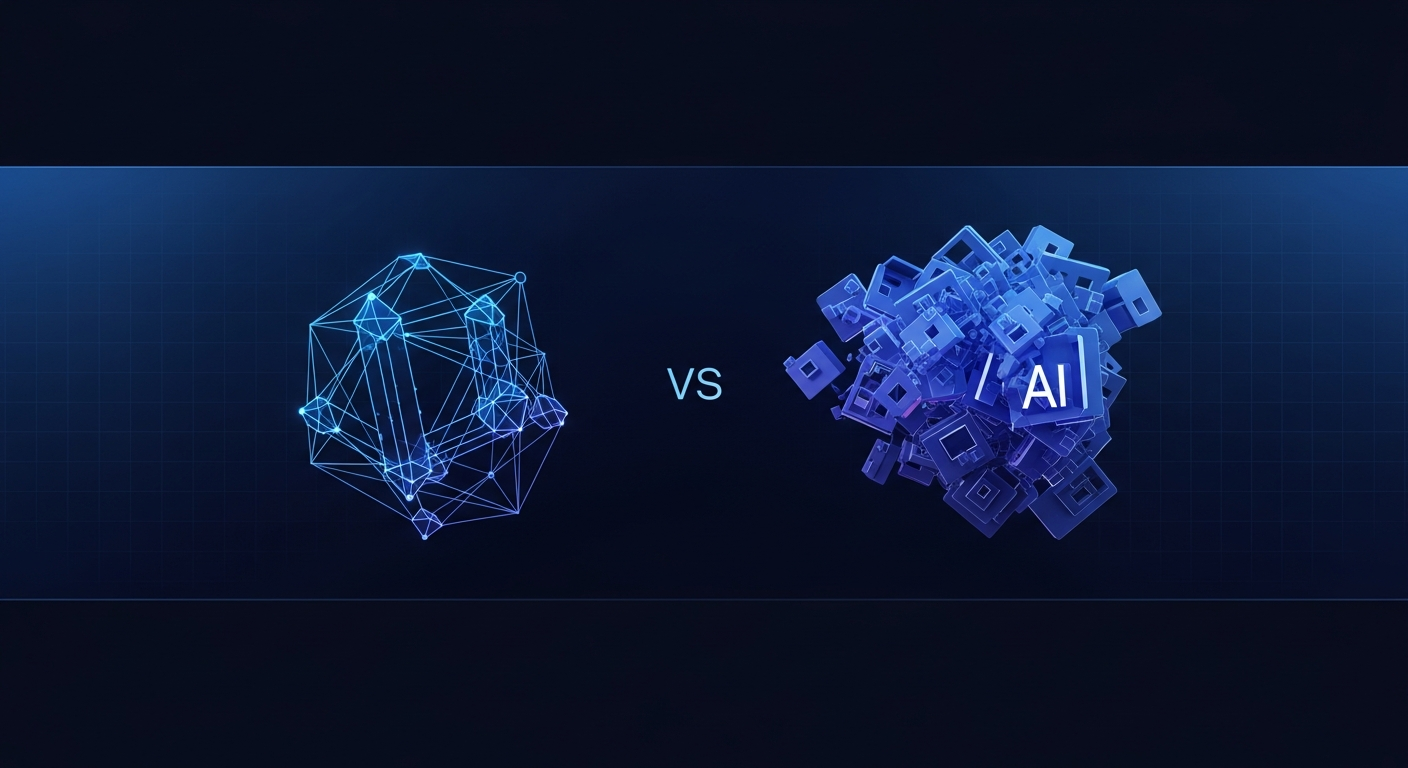
It's a fair question. Large language models are remarkably good at interpreting code and producing visuals. But there's a real difference between a diagram that looks right and one that is right — and that difference matters depending on what the diagram is for.
The honest answer is that both approaches have a place. This post is about which workflow each one fits.
What "AI-Generated" Actually Means#
Tools like Eraser AI and the AI annotation modes in terravision work by sending your Terraform (or a description of it) to a large language model, which produces a diagram description that gets rendered visually.
The properties this gives you:
- Fast and flexible. Paste a few hundred lines of HCL and get a polished diagram in seconds.
- Good at explanation. AI can add context, labels, and prose that a deterministic renderer wouldn't think to add.
- Probabilistic. Same input, different output. Run it twice and you get two diagrams that look broadly similar but differ in layout, naming, and sometimes in which resources got included.
That last property is the one that matters. Probabilistic isn't bad — it's just a constraint you need to know about.
What "Deterministic" Actually Means#
A deterministic diagram tool reads your Terraform with a fixed algorithm and emits the diagram with a fixed layout. The same Terraform always produces the same diagram.
The properties this gives you:
- Reproducible. A commit ID maps to one and only one diagram.
- Diff-able. Two diagrams from two commits can be compared visually because the layout is stable.
- Verifiable. An auditor or reviewer can re-run the tool and get the same output — no "well, the AI saw it differently this time."
- Less narrative. A deterministic tool won't write you a paragraph of explanation. It draws what's there.
This is what Infragr.am does, and it's the approach most hosted diagram tools take. Pluralith, Brainboard, and Holori are all deterministic in their core rendering. We compare all of them in our tools roundup.
When AI Is The Right Call#
AI-generated diagrams are great when the diagram is the product, not the evidence.
- Slides and pitch decks. You want something polished and labeled. Determinism doesn't matter.
- Early sketches and RFCs. You're describing a proposed system before any Terraform exists. AI can turn a paragraph into a draft diagram.
- Onboarding explainers. A long-form annotated diagram with context-rich labels is exactly what AI does well.
- Documentation handoff. Generating a one-time architectural narrative for a customer or a partner team.
In all of these, the diagram is a story. The point is human understanding, not machine verification.
When Determinism Is Required#
The list flips entirely when the diagram has to be trusted by a system or a process.
Code review#
A pull request reviewer is comparing the architecture before and after a change. If the diagram regenerates differently each time the PR is updated, the reviewer can't visually compare. They're left reading the HCL diff, which is what they wanted to avoid. We cover this workflow in detail in How to Add Architecture Diagrams to Terraform Pull Requests.
Compliance and audit#
Auditors need evidence, not narrative. A diagram that's traceable to a specific commit, generated by a known algorithm, is an artifact. An AI-generated diagram is an interpretation, and interpretations aren't evidence. When an auditor asks "show me your network architecture as of Q1," the answer needs to be a document, not a model output.
Drift detection#
Architectural drift — resources moving between zones, gaining unexpected dependencies, falling out of compliance — is detectable only if you can compare states. That requires the diagram to be a stable function of the underlying Terraform. AI-generated output breaks the comparison.
Onboarding to existing systems#
This one's subtle. When a new engineer is learning a system, they're going to look at the diagram more than once over their first month. If the diagram looks different every time, they spend energy reconciling visual differences instead of learning the architecture. We dig into this in Cognitive Debt: The Hidden Cost of Infrastructure as Code.
Reviewing AI-generated code#
This is the meta-point. More Terraform is being generated by Copilot, Claude Code, and various IaC generators every quarter. That code still needs review. If your review tool is also AI-generated, you've stacked probabilistic systems on top of probabilistic systems, and the review step provides no real verification. A deterministic diagram is what makes AI-written infrastructure safe to merge.
The Hybrid Workflow Most Teams Land On#
In practice, teams that think about this end up using both, for different things:
- AI for ideation and narrative. Sketching new systems, generating documentation, explaining architecture to non-engineers.
- Deterministic for verification and operations. Code review, compliance, drift detection, incident response.
The two aren't competing. They're optimized for different questions. AI answers "what could this look like?". Deterministic tools answer "what does it actually look like, and what changed?".
A useful test: if you imagine showing the diagram to two different people — your CEO and your auditor — and they should both be looking at the same artifact, you need determinism. If they're looking at different artifacts that share a name, you can pick the right approach for each.
FAQ#
Can a deterministic tool use AI for anything?#
Yes, in places that don't affect the diagram itself. Infragr.am, for example, uses AI for natural-language descriptions of changes (in MCP responses and summary text) but the diagram rendering itself is fixed. The diagram is the artifact; the AI is wrapping.
What about AI-augmented deterministic tools?#
Some tools (terravision, for example) layer AI annotations on top of deterministic rendering. This is fine if you can turn the AI part off when you need pure determinism. Make sure the toggle is explicit, not implicit.
Is deterministic output less expressive?#
It's less narrative. The layout doesn't shift to emphasize the thing you're currently asking about. The trade-off is that you can rely on it — the position of a resource in the diagram has meaning across versions. AI-generated layouts don't carry that meaning.
Will Google care about this distinction?#
For SEO purposes, probably not. For trust signals on documentation and audit artifacts, increasingly yes. Search engines and downstream consumers are starting to differentiate AI-generated content from machine-verifiable content; the same distinction is showing up in compliance contexts.
Should I pick a tool that does both?#
Yes, if it does both well and lets you choose explicitly. The worst outcome is a tool that's quietly AI-augmented when you thought it was deterministic. Ask vendors directly: "Is your rendering algorithm deterministic? Can I prove it by running it twice?"
Closing#
Use AI to generate your infrastructure code. Use AI to draft narratives and slides. Use deterministic tools to verify, review, and audit. The two are complementary parts of a modern platform engineering workflow — not competitors. The distinction is what the diagram is for, and most teams need both, in the right places.
- determinism
- ai
- compliance
- audit
- comparison
See your own architecture on every PR
Infragr.am renders Network, Compute, Data and Security diagrams from your Terraform plan. Collection and secret stripping run on your runner; only a sanitized bundle leaves it.